
Is HIV an Autoimmune Disease?
 Korbin
|
Korbin
|
 23 Dec 2025
Starting with the confusion — why people ask this question
A lot of people hear that HIV attacks the immune system and immediately assume it must be an autoimmune disease. It sounds logical on the surface. Immune system involved, long-term condition, serious consequences. Online searches don’t help much either — information gets mixed, terms get blurred.
At Sanford Pharmacy, this question comes up pretty often, especially from people who are newly diagnosed or from family members trying to understand what’s really happening in the body. The short answer is no, HIV is not an autoimmune disease. But stopping there doesn’t really help. The why matters.

First, what an autoimmune disease actually is
Autoimmune diseases happen when the immune system gets confused.
Instead of protecting the body, it starts attacking healthy cells, tissues, or organs. There’s no outside infection driving this. The immune system is misfiring on its own.
Conditions people usually recognize fall into this group. Lupus. Rheumatoid arthritis. Multiple sclerosis. Different organs, different symptoms, but the same core problem underneath.
The key idea is simple: in an autoimmune disease, the immune system is attacking the body itself.
What HIV actually is
HIV is not the immune system attacking anything. It’s the opposite.
HIV is a viral infection, caused by the human immunodeficiency virus. An outside virus enters the body and targets the immune system directly. So instead of the immune system making a mistake, it’s being attacked.
This difference sounds subtle, but it’s huge. It’s the main reason HIV is not classified as an autoimmune condition and never has been.
How HIV affects the immune system
HIV goes after very specific immune cells called CD4 cells, sometimes called T-helper cells. These cells act like coordinators. They don’t fight infections alone — they tell the rest of the immune system what to do.
As HIV replicates, it slowly damages and reduces the number of CD4 cells. With fewer coordinators around, immune responses become weaker and less organized.
At Sanford Pharmacy, this is often explained as the immune system losing its leadership. The army is still there, but no one is giving clear instructions.
Why HIV is NOT classified as an autoimmune disease
This is where the classification really matters.
In HIV:
-
The immune system is not attacking healthy tissue
-
There is no mistaken immune response
-
The damage comes from a virus infecting immune cells
Autoimmune diseases are internal errors. HIV is an external infection.
That’s why HIV falls under infectious diseases and immunodeficiency disorders, not autoimmune disease categories. Even when the immune system is badly damaged, the cause is still the virus.
Why the confusion still makes sense
Even though HIV vs autoimmune disease are medically very different, the confusion isn’t unreasonable.
Both involve immune system problems.
Both can be chronic.
Both often require long-term medication.
Both can affect many parts of the body.
From the outside, they can look similar. Under the hood, the mechanisms are completely different.
Can HIV cause autoimmune-like problems?
Yes, and this is where things get messy.
People living with HIV can develop autoimmune conditions. HIV immune dysregulation can sometimes trigger abnormal immune responses. In some cases, autoimmune diseases become more noticeable after HIV treatment starts and the immune system wakes back up.
Sanford Pharmacy pharmacists usually describe this as a secondary effect. HIV itself is not autoimmune, but immune imbalance can open the door to autoimmune issues in certain people.
That doesn’t change how HIV is classified, but it does explain some of the overlap people read about.
What happens when HIV is untreated
Without treatment, HIV keeps replicating. CD4 counts continue to drop. The immune system becomes less capable of fighting even common infections.
Eventually, opportunistic infections appear. This stage is called AIDS.
AIDS is still not an autoimmune condition. It’s advanced immunodeficiency. The immune system isn’t overactive — it’s exhausted and depleted.
How HIV treatment changes the picture
Modern HIV treatment changes everything.
Antiretroviral therapy, or ART, stops HIV from replicating. CD4 counts stabilize or recover. The immune system regains structure and strength.
At Sanford Pharmacy, one of the most important points pharmacists stress is this: HIV treatment protects the immune system. It doesn’t suppress it. That’s a major difference compared to how autoimmune diseases are treated.
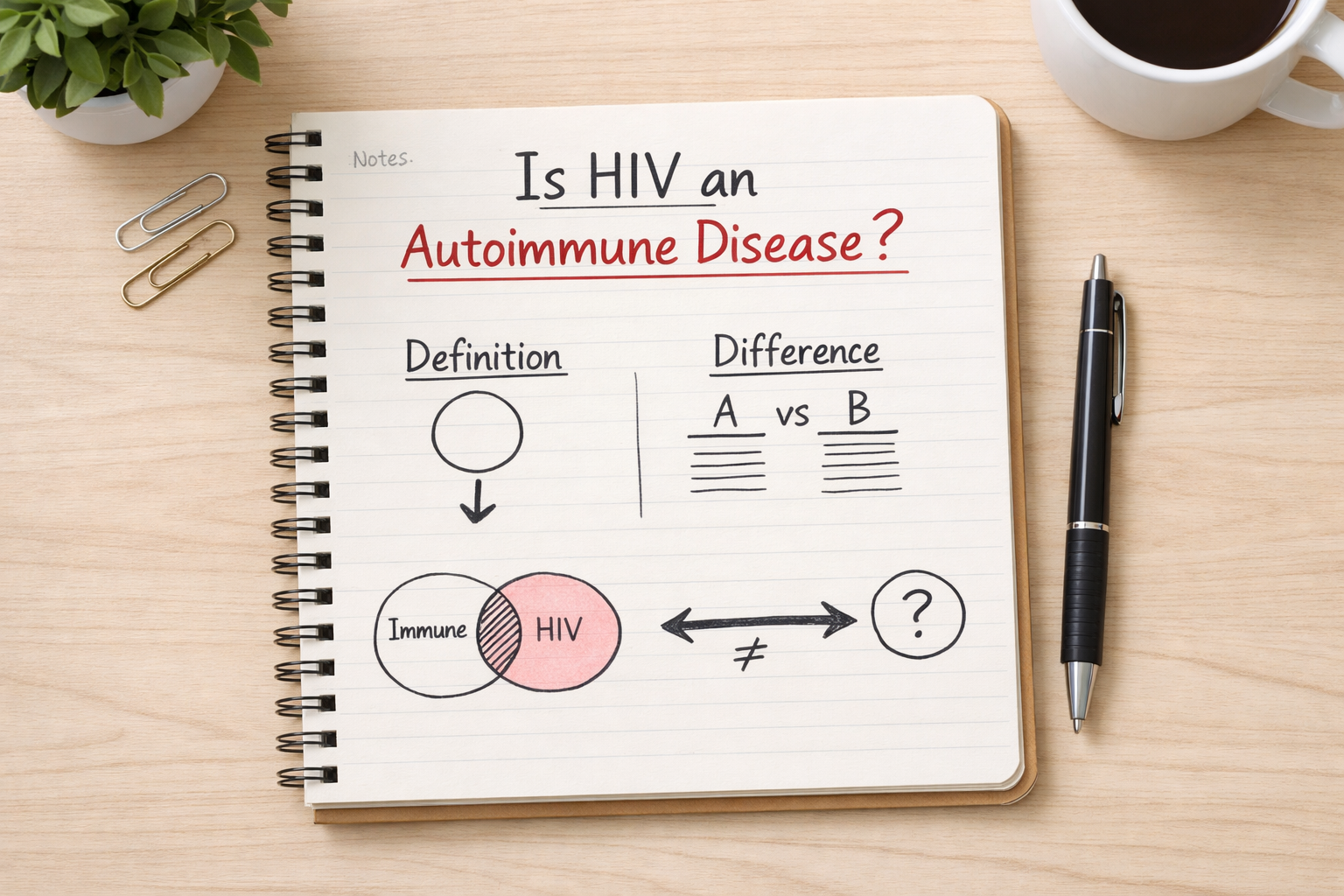
Autoimmune disease vs HIV — a simple comparison
Autoimmune disease: immune system attacks the body
HIV: virus attacks immune cells
Autoimmune disease: immune system is overactive
HIV: immune system becomes weak
Autoimmune disease: treated with immune suppression
HIV: treated with antiviral therapy
Seeing it side by side usually clears things up quickly.
Common questions people ask
Can someone have HIV and an autoimmune disease at the same time? Yes.
Does HIV make autoimmune diseases worse? Sometimes.
Is AIDS an autoimmune condition? No.
Why do HIV symptoms change so much over time? Immune strength changes.
These questions come up a lot, and none of them are silly. The immune system is complicated, even without a virus involved.
Why understanding this difference matters
Knowing whether HIV is an autoimmune disease isn’t just a technical detail.
It affects how HIV is treated.
It influences medication choices.
It helps reduce fear and stigma.
It helps people understand what their body is actually dealing with.
At Sanford Pharmacy, education is a big part of care. When people understand how HIV affects the immune system, they’re more confident with treatment and more consistent with medications.
Closing takeaway
HIV is not an autoimmune disease.
It’s a viral infection that weakens the immune system by attacking key immune cells. While HIV can cause immune imbalance and even trigger autoimmune-like problems in some cases, the root cause is completely different.
For questions about immune health, HIV medications, or long-term management, Sanford Pharmacy pharmacists are often a steady, practical source of clear guidance.
Categories


Can Recurrent Utis Be a Sign of Cancer
Jose
How Does Hydroxychloroquine Work?
Ali
Morning vs Night: Optimizing Blood Pressure Medication Timing
Arely
Natural Thyroid Hormone Therapy for Hypothyroidism Explained
Dulce

What Is Raloxifene Used For?
Abdullah
.webp)
.webp)
-(2).webp)
.webp)