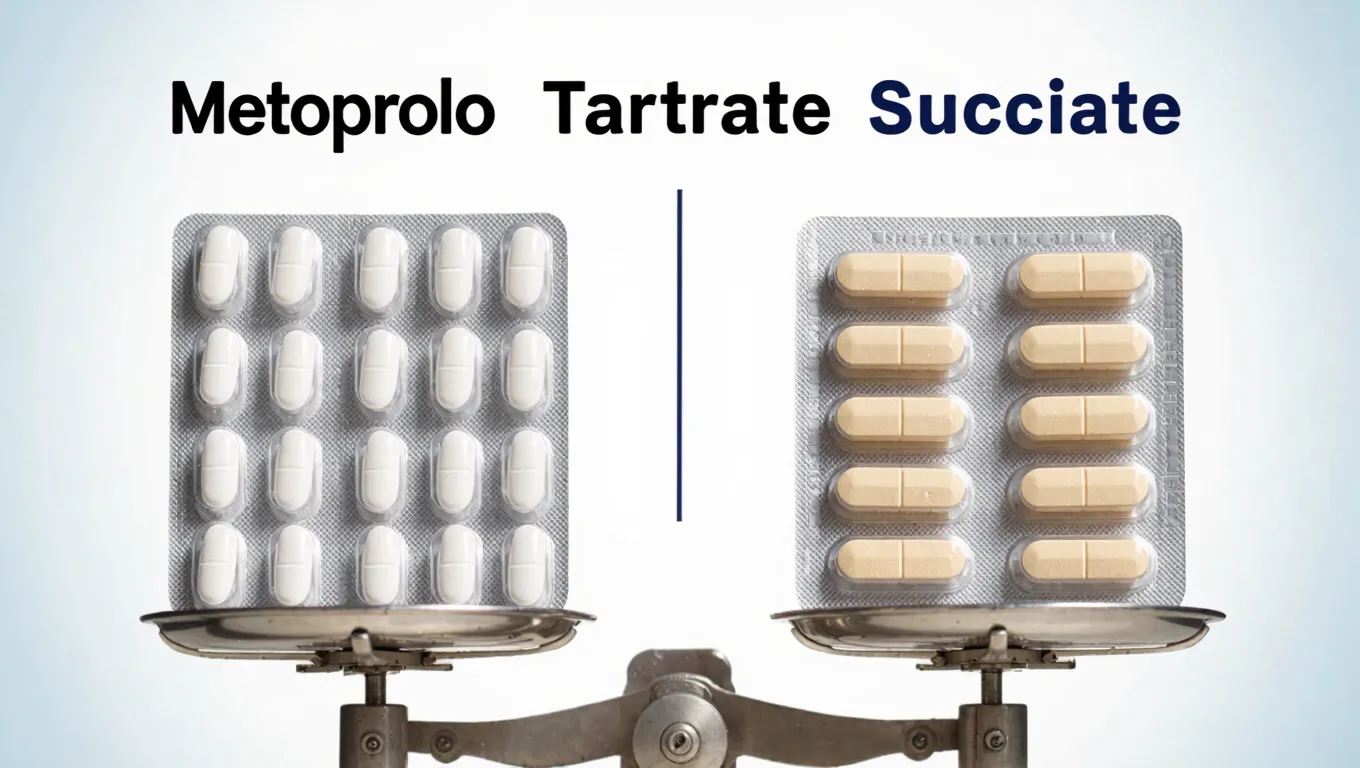
Comparing metoprolol tartrate and succinate is related to two pharmaceutical formulations of the beta-blocker metoprolol. Metoprolol tartrate is an immediate-release medicine, while metoprolol succinate is an extended-release formulation. These drugs act similarly but should not be swapped without consulting a healthcare professional.
The fundamental difference between metoprolol tartrate and succinate does not relate to the mechanism of action. The difference is the formulation and the release.
Metoprolol tartrate is an immediate-release form of metoprolol. This means that the drug is delivered relatively fast, and patients usually have to take divided doses of it.
Metoprolol succinate is an extended-release formulation. This means that the drug is delivered gradually during the day and does not need divided dosing.
This is why you cannot treat the comparison of metoprolol tartrate and succinate as two identical drugs having different names.
How Does Metoprolol Tartrate Work?
Metoprolol tartrate is an immediate-release beta-1 selective beta blocker.
Once this drug is delivered, it reduces the effect of stress hormones on the heart. It can:
- Reduce heart rate
- Decrease the intensity of heart contractions
- Lower blood pressure
- Reduce the heart's oxygen demand
As immediate-release metoprolol is not the extended-release formulation, the prescribed dose may be divided during the day.
Metoprolol tartrate can be prescribed for high blood pressure and angina. Also, it can be prescribed for heart attack recovery in some patients.
The required dose and the administration schedule may vary depending on the reasons of the prescription.
How Does Metoprolol Succinate Work?
Metoprolol succinate also provides a beta-blocking effect, but it is an extended-release form.
Instead of the rapid release of the drug, the release of it is gradual.
It helps to get a more constant beta-blockade during the day and allows to get the drug once a day.
Metoprolol succinate extended-release is prescribed for:
High blood pressure
Angina
Some types of heart failure
Once-daily administration can help to keep the dosing schedule when using metoprolol long term.
Metoprolol Tartrate vs Succinate: Comparison
Here are the main points to be considered when comparing metoprolol tartrate and succinate:
Release type: Immediate-release vs extended-release.
Frequency of dosing: Tartrate is usually taken once or several times a day. Succinate is usually taken once daily.
Duration of release: Succinate is specifically formulated to provide a gradual release during a day.
Uses: Some overlap (hypertension and angina), but the approved uses are not the same.
Heart failure: Metoprolol succinate extended-release is approved for the treatment of certain patients with heart failure.
These features have to be considered when comparing metoprolol tartrate vs succinate dosing frequency.
Which Form of the Drug Is Prescribed for High Blood Pressure?
Both types of metoprolol can be used to reduce blood pressure. But when comparing metoprolol tartrate vs succinate to choose the most appropriate one, you should consider such factors as your medical history, treatment goals, concurrent medication, etc.
Metoprolol can reduce blood pressure by slowing the heart and reducing the cardiac workload.
In case of the administration of metoprolol tartrate, the patient has to observe the prescription schedule strictly as the missed doses cause the gaps between medication effects.
As for metoprolol succinate, once-daily administration results in the gradual release pattern.
Neither of the formulations can be switched just for convenience reasons without a consultation with the prescriber.
Metoprolol Succinate for Heart Failure
The distinction is particularly important when comparing metoprolol tartrate vs succinate for heart failure.
Metoprolol succinate extended-release is approved for the treatment of certain patients with stable heart failure. This therapy requires a gradual dose increase according to tolerance and the clinical effect.
The treatment can affect heart rate, blood pressure, and the symptoms of the heart failure initially.
This is why the dose increase is performed individually under the supervision of the healthcare provider.
Metoprolol tartrate cannot be substituted because it contains the same active drug and has the different release pattern and the evidence of efficacy.
The patients with heart failure have to use the prescribed metoprolol formulation.
Metoprolol Tartrate After Heart Attack
Metoprolol tartrate is one of the medicines used for the treatment of certain patients with myocardial infarction and heart attack recovery.
Slowing the heart and reducing the cardiac workload can be useful for the patients.
But the treatment in this case requires the individual approach. The medicine, dosing schedule, and other aspects of the treatment depend on such factors as:
- Blood pressure
- Heart rate
- Cardiac function
- Other diseases of the cardiovascular system
- Concurrent medication
The metoprolol regimen of the patient may be changed in case when his/her care goes from the acute hospital setting to the long-term treatment.
Are the Doses of Metoprolol Tartrate and Succinate the Same?
Questions about the doses of the two formulations of the drug are common. This is due to the fact that both of them have the same number of milligrams.
But it doesn't mean that the patient can exchange the tablets independently.
The two salts are formulated in a different manner and have different release profiles. Sometimes the healthcare provider may switch a patient from one formulation to another. But this decision has to be made carefully.
When the switching is necessary, the equivalent treatment plan is defined according to such factors as the daily dose of the metoprolol, indication, patient's reaction, etc.
Do not split doses, combine tablets, and substitute formulations without the instruction of the prescriber.
Can Metoprolol Tartrate and Succinate Be Switched?
can metoprolol tartrate and succinate be used interchangeably is the question of medication safety.
The healthcare provider can change the formulation of the drug when necessary, but the two medications are not always interchangeable for the patient.
The switching can change the following things:
- Frequency of the medication
- Drug delivery pattern
- Time when the peak effect occurs
- Strength of the tablets required
Blood pressure and heart rate may be monitored during the formulation and dosing schedule change.
If the patient notices that his/her refill has suddenly changed or the label has changed from tartrate to succinate, he/she has to talk to the pharmacist before taking it.
Do They Have the Same Side Effects?
As both formulations contain metoprolol, the possible side effects are similar.
The list includes:
- Tiredness
- Dizziness
- Slow heart rate
- Low blood pressure
- Shortness of breath in sensitive patients
- Cold hands or feet
- Gastrointestinal symptoms
- Reduced exercise tolerance in some patients
Metoprolol can reduce the warning signs of low blood glucose in case of diabetes.
The exact side effects can depend on such factors as the dose, delivery pattern, medical condition, concurrent medication, etc.
This is why the comparison of the metoprolol tartrate and succinate side effects should take into consideration something else except the name of the formulation.
Which Form of Metoprolol Lasts Longer?
When comparing metoprolol tartrate and succinate, the question of the duration of the effect is common.
Metoprolol succinate is specifically formulated to have a long release pattern.
Tartrate releases metoprolol faster and may need divided dosing to achieve the clinical effect.
But this doesn't mean that succinate is "stronger." It means that the drug has a different release pattern.
The extended-release pattern can improve the convenience of the use for the patient with difficulties in multiple dose taking.
Is Metoprolol Succinate Stronger Than Metoprolol Tartrate?
Metoprolol succinate cannot be considered stronger than metoprolol tartrate.
The difference is the formulation, duration of the release, and indication.
The strength of the formulation with a particular dose shouldn't be estimated based on the number of milligrams on the package.
The dose is defined individually to achieve the desired beta-blocking effect.
How to Take Metoprolol Tartrate or Succinate Safely
The consistency is the key aspect of the therapy with metoprolol.
Some recommendations about safe medication use include:
Using the drug exactly according to the prescription.
Observing the dose and timing of administration.
Consistent taking of the drug every day.
Following the instructions about the taking of metoprolol before or after the meal.
Do not change the drug formulation yourself.
Checking your heart rate or blood pressure if the healthcare provider asks you to do so.
Reporting dizziness, faintness, and unusually slow pulse to your prescriber.
The extended-release formulation of the drug may be divided if it is scored and the instructions allow it. But the pills shouldn't be crushed and chewed as it will interfere with the extended release pattern.
Always follow the instructions provided for your particular formulation.
Why You Should Not Stop Taking Metoprolol Suddently
The abrupt cessation of the beta-blocker therapy is contraindicated for people with coronary artery disease.
It can exacerbate the symptoms of angina and increase the risk of serious heart complications in some patients.
In case metoprolol has to be discontinued, the healthcare provider can suggest gradual reduction of the dose.
Do not stop taking the medicine because of your blood pressure or heart rate improvement as it happens due to metoprolol.
What Can Happen if You Take the Wrong Form of Metoprolol?
Taking the wrong metoprolol formulation can affect the drug delivery pattern.
For example, the accidental switching of extended-release succinate to immediate-release tartrate can change the consistency of the delivery of the drug during the day.
It can result in the insufficient beta-blockade during some periods of time or the opposite result.
In case you have accidentally taken the wrong formulation, contact your pharmacist or prescriber for the recommendation. Do not try to correct the mistake by taking additional pills without the instruction of the prescriber.
Medical help is required if you have the following symptoms after the wrong taking:
- Fainting
- Strong dizziness
- Very slow heartbeat
- Difficulty breathing
- Weakness
- Chest pain

How to Determine Which Metoprolol Formulation You Are Taking
The easiest way to find out which metoprolol formulation you have is to read the prescription label carefully.
Find the information about:
Metoprolol tartrate
Metoprolol succinate extended-release
ER
Extended release
XL
Also pay attention to the recommended frequency of administration.
Do not rely on the pill's color and shape alone as the generics manufacturers can make pills of different appearance.
If the formulation is unclear, Sanford Pharmacy can determine the medication and its dosing instructions for you.
Frequently Asked Questions
What is the difference between metoprolol tartrate and succinate?
What is the difference between metoprolol tartrate and succinate? The difference between them mainly relates to the formulation and duration of the release. Tartrate is the immediate-release formulation, while succinate is the extended-release formulation that is taken once daily.
Why is metoprolol succinate taken once daily?
Its extended-release formulation provides the gradual delivery of metoprolol during the day, which allows to take it once daily.
Which metoprolol is used for heart failure?
Metoprolol succinate extended-release is the formulation specifically used for the treatment of certain patients with heart failure. The treatment is individual and has to be titrated carefully.
Can you switch from tartrate to succinate?
Yes, the switch can be performed when it is appropriate. The dose and schedule have to be defined professionally.
Do both forms lower heart rate and blood pressure?
Yes, both formulations provide metoprolol and can decrease heart rate and blood pressure.
Is glipizide better than –Wait, it is not relevant. Ignore.
What should you do if the pharmacy dispenses a different metoprolol formulation?
Do not suppose that it is the equivalent substitution. Check the label first, and then consult the pharmacist if the salt or release type are different from usual.
Sanford Pharmacy can also help to determine the drug and its dosing schedule in case your refill looks different from expected.
Medical References
DailyMed – Metoprolol Tartrate Tablets, Official Prescribing Information
https://www.dailymed.nlm.nih.gov/dailymed/drugInfo.cfm?setid=a401fe31-d51a-49d9-a062-c9d22088db56
DailyMed – Metoprolol Succinate Extended-Release Tablets, Official Prescribing Information
https://www.dailymed.nlm.nih.gov/dailymed/drugInfo.cfm?setid=74e3b4dc-eb30-4d7c-a558-cf58f6470496
MedlinePlus – Metoprolol Drug Information
https://medlineplus.gov/druginfo/meds/a682864.html
Categories



How Long Does Tamsulosin Take to Work?
 Emma

Amoxicillin vs Azithromycin: What’s the Difference?
Emma

How Long Does Montelukast Take to Work?
Emma

Fluoxetine Side Effects: What to Expect
Emma
When Is the Best Time to Take Hydrochlorothiazide?
Emma