
How to Take Clomid to Get Pregnant
 Krista
|
Krista
|
 25 May 2026
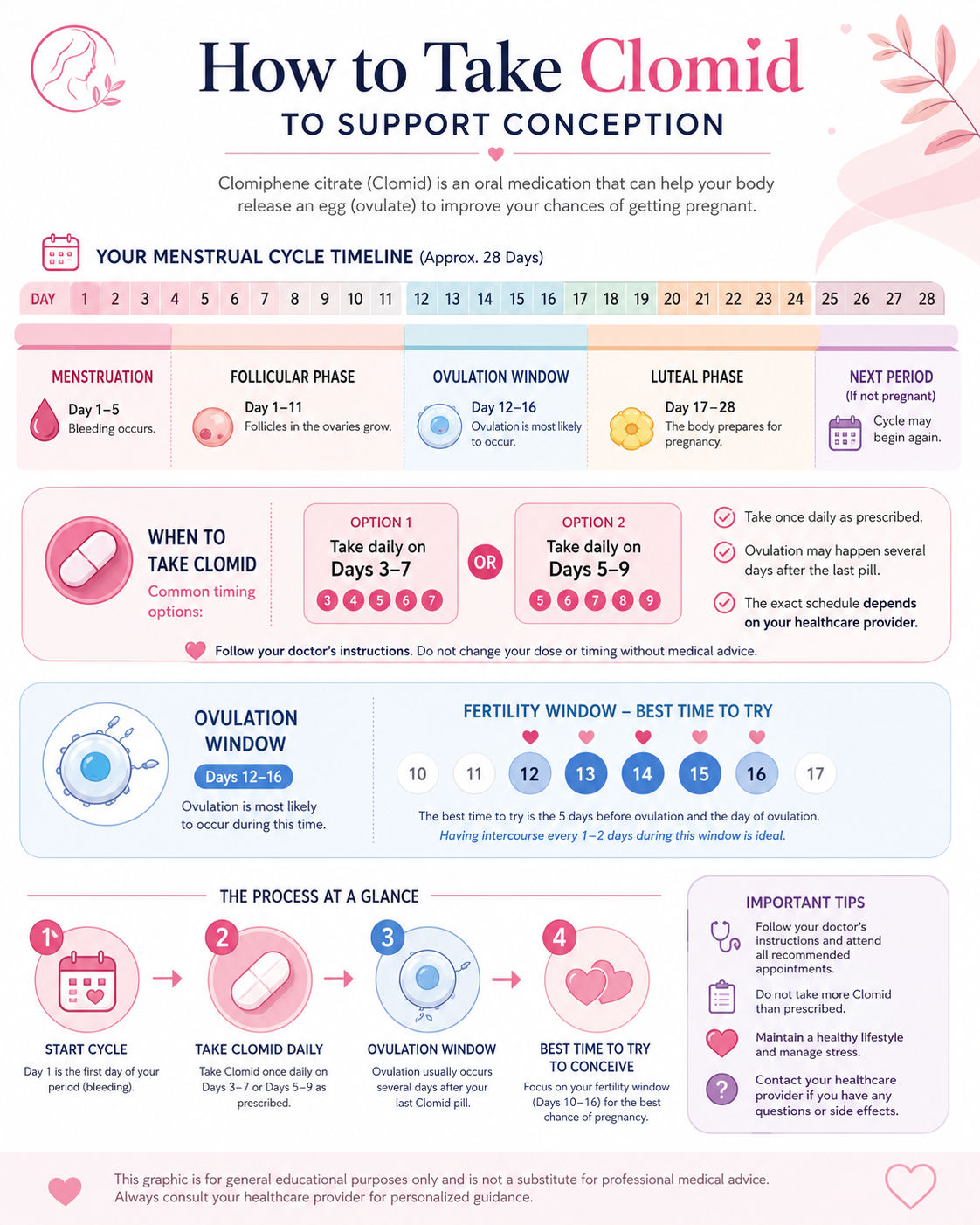
Clomid, you might also hear it called clomiphene citrate, is usually taken one time a day for about five days, early in the menstrual cycle. In most cases it gets started on day 3, 4 or 5 of the period. Day 1 counts as the very first day you have bleeding. Now, the exact day you begin isn’t just random, it’s picked according to how your cycles generally behave and what your doctor is trying to accomplish.
Also, Clomid doesn’t make ovulation happen right away while you’re still taking it, and this is kind of easy to miss so it’s important to grasp it fully. It doesn’t directly trigger ovulation in the moment. Instead it works by shifting how your body processes certain hormones. You can think of it as acting within the brain, mostly changing the way estrogen messages are interpreted. Then your system responds by raising hormones like FSH and LH, and those are the ones that prompt the ovaries to do their job.
So the process takes a few days. The tablets are taken first. Then the body responds. Then ovulation happens later.

When to Start Clomid in Your Cycle
Treatment always starts early in the cycle, but not at the exact same point for everyone.
Day 1 is the first day of menstrual bleeding. From there, the usual starting points are:
- day 3
- day 4
- day 5
Once started, the tablets are taken for five days in a row. No gaps in between.
Some people follow a day 3 to day 7 schedule. Others use day 5 to day 9. Both are standard. The difference comes down to how the ovaries are expected to respond.
Starting earlier can sometimes lead to more follicle development. Starting slightly later may be used when a more controlled response is preferred. This isn’t something to adjust on your own. It’s based on how your body has responded before, or what the doctor expects.
How to Take Clomid Correctly
The medication is taken as a tablet, once a day.
It helps to take it at roughly the same time each day. It doesn’t have to be exact, but consistency matters.
It can be taken with food or without. There’s no strict rule for that. Some people prefer taking it with food if they feel mild nausea, but it’s not required.
The tablet should be swallowed with water. Doses should not be skipped. If one is missed, it’s better to ask what to do next rather than trying to adjust it yourself.
The starting dose is often 50 mg daily. If ovulation doesn’t happen, the dose may be increased in later cycles.
When Ovulation Happens After Taking Clomid
Ovulation doesn’t happen during the five days of tablets.
It usually happens later. Most commonly between 5 and 10 days after the last dose.
That window can shift a little depending on how your body responds. Some people ovulate earlier in that range. Others closer to the end.
What matters is that this is the time when the ovary releases an egg. That’s the point when pregnancy can occur.
Best Time to Try for Pregnancy While on Clomid
Because ovulation happens in that window, timing matters.
A common approach is to have intercourse every 1 to 2 days during that period.
That way, sperm are already present when ovulation happens.
Some people use ovulation predictor kits. These detect hormone changes just before ovulation. They can help narrow the timing further.
In some cases, doctors monitor things more closely. That can include ultrasound to track follicle growth or blood tests to confirm ovulation. That level of monitoring depends on how the treatment is being managed.

Signs That Clomid Is Working
The main sign is ovulation itself.
Sometimes people notice changes, sometimes they don’t.
Possible signs include:
- a positive ovulation test
- cervical mucus becoming clearer and more stretchy
- mild lower abdominal discomfort around ovulation
- cycles becoming more regular
But not everyone feels these changes. Some people ovulate without any obvious symptoms.
So absence of symptoms doesn’t mean it isn’t working.
What If You Don’t Ovulate on Clomid
Not ovulating in the first cycle is not unusual.
If that happens, the next step is usually to adjust the dose.
The dose may be increased in the next cycle to see if the ovaries respond better.
Sometimes monitoring is added. That helps see whether follicles are developing and how they’re responding.
If ovulation still doesn’t occur after several cycles, then other options are considered. That might involve different medications or other fertility treatments.
Important Safety and Usage Considerations
Clomid is not used continuously without limits.
Most treatment plans involve a set number of cycles. Often around 3 to 6.
Using it longer than that isn’t usually recommended unless there’s a specific reason.
The medication can also lead to more than one follicle developing. That increases the chance of twins compared to natural cycles.
Some side effects can occur.
These include:
- hot flashes
- mood changes
- abdominal bloating
These are related to hormonal changes. In most cases, they are temporary.
The medication should always be used under medical supervision.
When to Speak With Your Doctor
Follow-up matters with this treatment.
You should speak with your doctor if:
- ovulation does not occur
- cycles remain irregular
- side effects become difficult to manage
- pregnancy does not happen after several cycles
These situations usually mean something in the plan needs to be adjusted.
Fertility Support and Medication Guidance
Clomid treatment involves timing, consistency, and understanding how the cycle responds. Small differences can affect the outcome.
If there are questions about how to take it, or how to time things properly, pharmacists at Sanford Pharmacy can help explain the process clearly.
Additional information about fertility medications and treatment use is available at Sanfordpharmacy.com.
Knowing when to take the medication, what to expect after the last dose, and how ovulation fits into the cycle makes the process more manageable.
Categories



How to Take Clomid to Get Pregnant
Krista

How Does Acyclovir Cream Work?
Grayson
What Is Triclabendazole?
Deonte
How Long Does Oseltamivir Take to Work?
Nia
How Long Can You Take Prilosec?
Mikayla
.webp)
.webp)
-(2).webp)
.webp)