
What Are Normal Weight and Height Milestones for Babies?
 Skyler
|
Skyler
|
 10 Mar 2026
Understanding Infant Growth Charts and Healthy Development Stages
What Are Normal Weight and Height Milestones for Babies?
Normal baby weight and height milestones follow predictable patterns during the first year, although every baby grows at their own pace. Most infants double their birth weight by around 5 months and triple it by their first birthday, while growing roughly 10 inches (about 25 cm) in length during the first year. Pediatricians use a baby growth chart by age to track whether a baby’s weight and height are progressing in healthy ranges.
For parents, those charts can sometimes look confusing. A baby might be in the 30th percentile one month and the 40th the next. That doesn’t automatically mean something is wrong. Growth during infancy isn’t perfectly smooth. It tends to come in bursts.
Understanding the general baby growth milestones weight and height guide can make those checkups feel a lot less stressful.

Average Baby Weight Milestones in the First Year
The first year of life is when babies grow faster than at any other time.
At birth, most full-term babies weigh somewhere between 5.5 and 8.8 pounds (2.5–4 kg). That range is considered normal. Some babies start smaller, some larger. What matters more is how steadily they grow afterward.
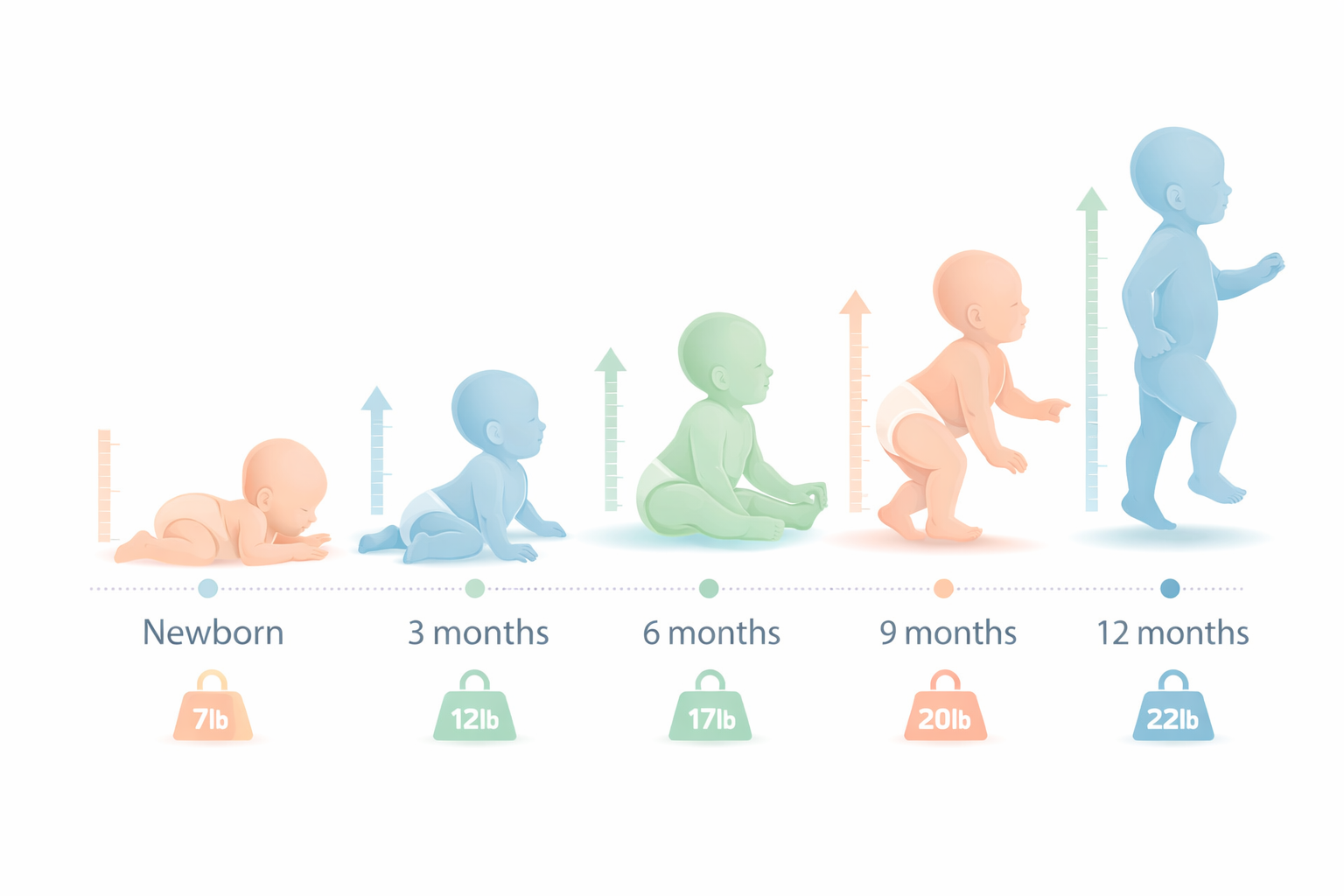
A typical normal baby weight by month looks roughly like this:
- Birth: 5.5–8.8 pounds (2.5–4 kg)
- 1 month: around 8–10 pounds (3.6–4.5 kg)
- 3 months: about 12–15 pounds (5.4–6.8 kg)
- 5–6 months: most babies double their birth weight
- 9 months: usually 17–22 pounds (7.7–10 kg)
- 12 months: birth weight typically triples
Weight gain tends to happen fastest during the first four to six months. Babies feed frequently during this stage and their bodies are growing rapidly.
After about six months, growth slows a bit. That’s normal. Babies start moving more, rolling, crawling, and eventually pulling themselves up.
Energy goes into development as much as growth.
Typical Height Growth Milestones During the First Year
Weight often gets the most attention, but length (or height) is just as important when doctors evaluate infant growth chart weight and height patterns.
At birth, babies are usually around 19–21 inches long (48–53 cm).
From there, the growth tends to follow a gradual pattern.
Typical average baby height by month milestones look something like this:
- Birth: about 19–21 inches (48–53 cm)
- 3 months: around 23–24 inches (58–61 cm)
- 6 months: about 25–27 inches (63–69 cm)
- 9 months: around 26–28 inches (66–71 cm)
- 12 months: usually 28–30 inches (71–76 cm)
During the first six months, babies often grow close to 1 inch per month. After that, the pace slows a little to roughly half an inch per month.
Again, these numbers are general guidelines. Some babies grow slightly faster, others a bit slower.
How Pediatricians Use Baby Growth Percentiles
Doctors don’t rely on a single number when they look at baby growth standards by age. Instead, they use growth percentiles.
Growth charts compare your baby with thousands of other children the same age.
They measure several things:
- Weight-for-age
- Length-for-age
- Weight-for-length
- Head circumference
A baby in the 25th percentile, for example, weighs more than 25% of babies their age and less than 75%.
Some parents worry if their baby isn’t near the top of the chart. But that isn’t necessarily important.
What pediatricians usually care about most is consistency.
If a baby tracks along the same percentile line over time, that’s often a sign that growth is healthy.

Growth Patterns During the First 12 Months
One thing that surprises many new parents is that babies don’t grow in a straight line.
Growth tends to happen in phases.
There are periods where a baby suddenly seems bigger almost overnight. Then things slow down again.
During the first few months, babies often gain weight rapidly. Feeding happens frequently, sometimes every two or three hours.
After around six months, growth slows a little as babies begin exploring movement and starting solid foods.
Parents often notice something else during the first year — growth spurts.
These usually appear around:
- 2–3 weeks
- 6 weeks
- 3 months
- 6 months
During these periods, babies may suddenly want to feed much more often. Sleep patterns can shift too.
It can feel exhausting for parents, but growth spurts usually settle down after a few days.
Factors That Influence a Baby’s Weight and Height
Every baby grows differently, and there are several reasons why.
Genetics play a big role. Parents who are naturally taller may have babies who grow taller as well. The same idea applies to body build.
Other factors can also influence the baby growth chart by month weight and height pattern.
These include:
- genetics and parental height
- premature birth
- feeding method (breastfeeding or formula)
- nutrition after introducing solids
- overall health
- sleep patterns
- activity level as babies begin moving more
Because of these differences, two healthy babies can grow at completely different rates.
That’s why pediatricians focus on growth trends rather than comparing babies to each other.
Differences Between Breastfed and Formula-Fed Babies
Parents sometimes worry when their baby’s growth pattern looks different from another child’s.
Feeding method can influence early growth patterns slightly.
Breastfed babies
- Often gain weight faster during the first 2–3 months
- Growth may slow slightly after around 6 months
Formula-fed babies
- May gain weight more steadily throughout the year
Both patterns can be completely normal. Doctors simply look for steady progress on the infant growth chart weight and height curves.
Consistency matters more than speed.
Signs That a Baby Is Growing Well
Parents often notice certain signs that their baby is developing normally.
Growth is usually reflected in everyday things.
You might see:
- steady weight gain at pediatric checkups
- increasing appetite
- clothes and diapers becoming tight
- improved energy and alertness
- new physical milestones such as rolling, sitting, or crawling
These signs generally indicate that nutrition and development are on track.
Growth and development tend to move together during the first year.
When Baby Growth May Need Medical Evaluation
Most variations in growth are completely normal. But sometimes doctors want to take a closer look.
Parents should speak with a healthcare professional if a baby:
- isn’t gaining weight over time
- stops growing in length
- drops noticeably on growth charts
- has persistent feeding problems
- seems unusually lethargic or dehydrated
In many cases the cause may be simple — feeding challenges, reflux, or temporary illness.
Early evaluation helps doctors identify issues before they become more serious.
Supporting Healthy Weight and Height Development
Parents don’t need to obsess over numbers to support healthy growth. Many of the most important things are surprisingly simple.
Babies grow best when their basic needs are met consistently.
Helpful habits include:
- feeding babies on demand during the early months
- introducing solid foods around 6 months, when recommended
- attending regular pediatric checkups
- allowing adequate sleep
- monitoring feeding patterns and hydration
Routine well-baby visits allow healthcare providers to track growth and offer guidance based on the baby’s individual development.
Those visits are often where doctors update the baby growth milestones chart and make sure everything is progressing normally.
For most families, those growth charts become reassuring over time. They show that even when development feels unpredictable day-to-day, babies usually follow a healthy path forward.
Categories



Can Recurrent Utis Be a Sign of Cancer
Jose

How Does Hydroxychloroquine Work?
Ali
Morning vs Night: Optimizing Blood Pressure Medication Timing
Arely

Natural Thyroid Hormone Therapy for Hypothyroidism Explained
Dulce

What Is Raloxifene Used For?
Abdullah

.webp)
.webp)
-(2).webp)

.webp)